IC 5134 and NGC 7129
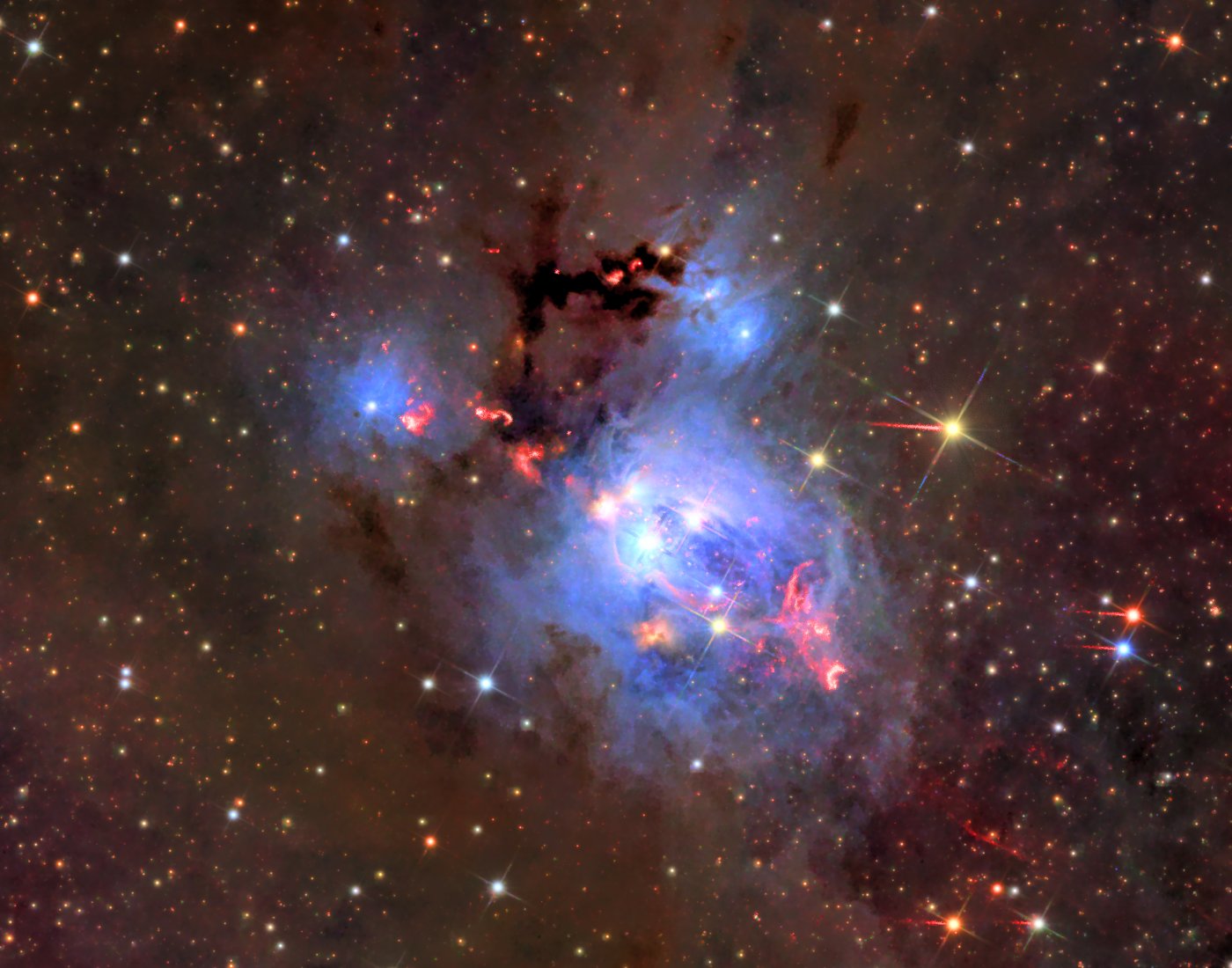
IC 5134 is a reflection nebula in the constellation Cepheus. It is illuminated by the cluster of young stars NGC 7129, located about 3000 light-years (900 pc) away. At this distance, the apparent diameter of the reflection nebula — about 0.2° — corresponds to a true diameter of roughly 10 light-years (3 pc). The nebula is surrounded by molecular clouds and HII regions.
In both images, NIR (near-infrared) is mapped to red, red to green, and blue to blue.
In the version with Hα, that emission line is added to the red channel.
Stars are partially subtracted to enhance the visibility of the nebulae.
IC 5134 is the blue nebula shaped by the stellar wind of the cluster.
The object lies within molecular clouds, which appear brownish in the image because the dust is more opaque to blue light than to longer wavelengths due to Rayleigh scattering.
(Some sources identify NGC 7129 as the reflection nebula and IC 5134 as part of it.
However, according to SIMBAD, NGC 7129 is a star cluster and
the OpenNGC catalog catalog lists IC 5134 as the larger object, though with comments noting that it is part of the smaller NGC 7129.)
The version with Hα (use the button to toggle it) also reveals many small emission regions within IC 5134 and large HII filaments (red).
The fine ones in the top left corner belong to the supernova remnant SNR G107.0+9.0.
The rays on bright stars on the right side in the Hα channel are caused by artifacts of the filter.


Hα: on


Image data
| FOV (full view in the JavaScript viewer): | 1.36° × 0.90° | ||||||||
|---|---|---|---|---|---|---|---|---|---|
| Position (J2000): | RA: 21h45m; DEC: 66°4′ | ||||||||
| Date: | 2023-2024 | ||||||||
| Location: | Pulsnitz, Germany | ||||||||
| Instrument: | 400mm Newton at f=1520mm | ||||||||
| Camera Sensor: | Sony IMX455 | ||||||||
| Orientation: | North is up (exactly in the image center) | ||||||||
| Scale: | 1 arcsec/pixel (at full resolution) | ||||||||
| Total exposure times: |
|
Image processing
No manual retouching was performed, all image-processing steps are deterministic, and none of the algorithms use machine learning (often referred to as “AI”), which tends to generate plausible-looking but artificial details. The software used can be downloaded here.The image processing steps were:
- Bias correction, dark current subtraction, flatfield correction, noise estimation
- Alignment and brightness calibration using reference catalogs
- Stacking with outlier rejection, background estimation and optimal weighting based on noise estimation
- Star subtraction where star positions and intensities are extracted from continuum images
- Denoising and deconvolution of both components (stars and residual)
- Dynamic range compression using non-linear high-pass filter
- Color composition and tonal curve correction
 RSS feed
News
Imprint
Media on this page can be used under Creative Commons Attribution-
RSS feed
News
Imprint
Media on this page can be used under Creative Commons Attribution-
Noncommercial-Share Alike 4.0 license or other licenses.
